Design coordination
Review the intended geometry, interfaces, support conditions, and project-specific engineering.
Casting System
SIP means Stay-In-Place. The panels are permanent formwork that is not dismantled after the concrete is placed: they are never struck, stripped or returned to the yard. It serves as structural insulation formwork with a finished mould surface: concrete fills the cavity, the assembly cures as one monolithic wall, and the panel face remains as the finished interior or exterior surface.
See the Casting a House Method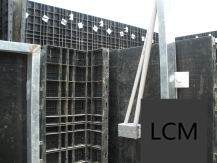
Because the formwork is never removed, the wall arrives already formed and already insulated. There is no stripping cycle, no cleaning, no transport back to the yard and no re-erection on the next level. The material is bought once and stays in the building.
The effect on programme and cost is direct: fewer site hours per square metre, fewer crane lifts, less waste, and a faster move from one floor to the next. The wall is complete when the concrete sets.
System Coordination
Technical scope is confirmed against local codes, structural design, materials, casting sequence and site conditions.
Review the intended geometry, interfaces, support conditions, and project-specific engineering.
Coordinate formwork installation with foam preparation, mixing, placement, and curing plans.
Include operating procedures and installation guidance in a broader technology-transfer program.
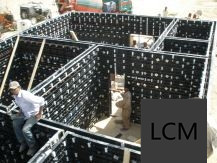
Use the detail view to record joint alignment, support spacing, bracing, and connection conditions. Dimensions and capacities must follow approved system documentation and the project engineer's design.
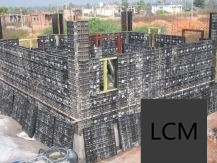
The site record captures pre-pour inspection, service placement, access and the planned sequence for filling and monitoring the assembly. Pressure, temporary supports and curing protection are checked against the approved method statement.
Share your project drawings and intended casting approach for an initial review.
Contact LCM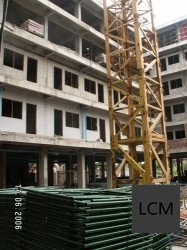
Technical Process
Every project is scoped around the same inputs: intended use, target output, local material sources, available utilities and acceptance criteria. Formulation, foam generation, mixing, transfer, placement and inspection are planned as one workflow, not as separate operations.
No dilution ratio or cement-to-sand ratio can be fixed in advance. The recipe is established from product data, the mix design and the materials on site, then qualified through trial mixes before production release. A generator delivers steady foam only inside its verified operating envelope, with output matched to mixing and placement; capacity, pressure and flow are confirmed with equipment data and commissioning measurements. Pump and hose performance follow the mix, the route, the lift and the rate of placement.
Foam density, fresh concrete density, workability, material consumption and interruptions are recorded on a repeatable sampling plan. Placed material is protected, and curing, demoulding, loading and follow-on trades follow approved project criteria and strength evidence; curing time varies with formulation, geometry, temperature and humidity. In SIP assemblies the formwork is never removed, so the wall arrives already formed and insulated, with any insulation or cladding contribution designed and verified for that assembly.
Coordinate before the pour
Check panel joints, bracing, reinforcement, openings, conduits, supports, and structural approvals.
Place under controlled conditions
Use qualified mix proportions and a planned sequence; monitor form movement, leakage, pressure, and fresh density.
Retain the useful formwork
Permanent formwork avoids a stripping operation and may contribute insulation or cladding when designed and verified for those functions.
Installation & assembly